• Blog
  • The True Cost To Start a Fashion Label in Australia
Clothing collection budget-:unit costing, import cost and selling margin spreadsheet

The True Cost To Start a Fashion Label in Australia

Visionise helps you make calculated decisions so that you can move forward with confidence

Starting a fashion label can be a dream for many, but turning that into a reality, like anything in life, takes a lot of time, money, grit and determination. When it comes to the future success of your business, it pays to crunch the numbers and here at Visionise, we’re all about being open and transparent with our clients not only about the manufacturing process but financial realities that come into play when it comes to the true cost to start a fashion label.

How much does it cost to start a fashion label in Australia?

If you want to start your own fashion label, make sure you take a look through the following guide as we outline all the items and what they cost to start a fashion label and launch your brand.

One of the best pieces of advice we’ve ever received when it comes to budgeting for your start-up fashion costs is to write down every single expense you can think of, and then double it.

This is what you should be prepared to spend as you launch your fashion label. From the initial business costs to design and development, bulk production and the various marketing activities and inevitable unexpected expenses you’ll encounter, you’ll soon come to learn you need substantially more than what you originally think. Before we get into the true cost to start a fashion label, let’s first explain the difference in fixed vs variable costs in your budget.

Some main factors that will determine your unit production cost
  • MOQ’s: Number of styles and colourways (the lower the MOQ, the higher the unit cost)
  • Product type: Smaller items generally require a higher MOQ
  • Complexity
  • Fabrics and trims: High-quality, certified, ethical & sustainable fabrics cost more
  • Factory Certification requirement: Ethical & sustainable practices cost more; certifications are expensive
  • Machinery needed: Some products require a higher MOQ due to the machinery (eg, circular knit, socks etc)

Your first collection will be the most expensive because you are doing everything from scratch; however, many of these jobs are not ongoing. Once your branding material, tech packs, patterns, and fabric etc are established, this can be re-purposed saving time and money moving forward.


Design & Development Costs at Visionise

We want to give you complete transparency on exactly what costs look like when working with Visionise Fashion Design and Manufacturing.

As part of our Fashion Framework Program, we structure the entire design and development phase into three clear, sequential steps. This gives you full visibility and dedicated budget meetings at the end of both Step 1 and Step 2, so you can make truly calculated decisions before moving forward.

For your first collection, the costs for each step are:

  • Step 1 – Design & Development: $2,750
  • Step 2 – Sample & Product Development: $1,530
  • Step 3 – Bulk Production Management: $1,530

These fees cover having a dedicated senior designer and production manager personally guide you through the entire process, essentially a comprehensive crash course in how to professionally develop and launch a fashion collection. This structured support is specifically designed to help you avoid the most common setbacks that derail new labels, save you significant time and money. Learn more here: The Fashion Framework

Within these steps you can also expect the following additional costs:

  • Tech packs: $408 – $750 per style (depending on complexity)
  • Sample reports: Typically $300-350 per style, you will need a report for each sample round ( typically 3 x sample rounds: Fit sample, proto samples and PP sample)
  • Physical samples: Usually priced at 3x the FOB (bulk unit cost) per sample (again, multiply that by 3 sample rounds)

Because we review your costs and budget at the end of Step 1 and Step 2, you have the opportunity to tweak styles, colours, fabrics, or pricing before any larger financial commitment is made.

Many of these early-stage costs are one-off investments that become the foundation for every future collection.

Our Fashion Framework program is specifically designed around a typical startup range: 5 styles with 2–3 colourways each. This structure allows us to deliver a focused, commercially viable first collection while keeping the process efficient and cost-effective for new labels. If your collection requires more than 5 styles, or if you need significant additional support during the initial idea stage (for example, if you don’t yet have a clear brief or specific direction), this will require extra time and iterations. In these cases, you can add hours to the design and development phase as needed.

We always discuss scope and expectations up front during our comprehensive budget meeting, so there are no surprises. Our goal is to work efficiently within your brief while ensuring the final collection is production-ready and aligned with your brand vision.


Understanding MOQ: Why Lower Quantities Don’t Always Mean Lower Costs

Many emerging designers believe that ordering the lowest possible MOQ will reduce risk and save money. However, the reality is often the opposite.

At Visionise, our MOQ starts at 25 pieces per style/colour with selected Bali partners. Most factories in China, Vietnam, India and Poland require 100 pieces per style/colour, with exception to some offering MOQ 50 for certain product categories (ready to wear ladieswear). Sizes are inluded as part of the MOQ per style/colour, however, if you requrire a larger size run than normal, this may affect the MOQ to increase.

Regardless of the MOQ per style/colour, the factories also require a total order MOQ of around 500 units across all styles and colours. Some may accept a total order of 300 units for certain product types. Total order MOQ does not apply for re-orders.

Lower MOQs typically result in:

  • Higher fabric and material up-charges
  • Less efficient production runs
  • Higher per-unit landed cost as fixed development and sampling expenses are spread across fewer pieces

This can quickly erode your gross profit margin.

We help our clients find the ideal “sweet spot” a quantity that minimises risk while properly testing the market and protecting healthy, sustainable margins. This is exactly why we recommend starting with at least 5 styles in 2 colourways and an MOQ of 100 (=1000 units) as the sweet spot for your first collection.


Example of cost for a start-up clothing brand

Generally speaking, when it comes to the true cost to start a fashion label in Australia, we strongly recommend a collection size of: 5 styles in 2 colourways each and MOQ of 100 = Total SKU of 1000 units)
This has become our proven sweet spot for emerging e-commerce brands. It strikes the perfect balance – giving your online store enough variety to attract and retain customers, while keeping the time and financial investment truly worthwhile. Most importantly, this is typically where a healthy profit margin (target of 70% gross margin based on landed cost) begins to materialise effectively.


Below is a realistic example for launching at this exact scale (5 styles / 2 colourways / MOQ 100 / total 1,000 pieces) . Many of the early-stage costs (design, tech packs, sampling, branding, and packaging) are one-off investments that support future collections, making your second and third drops significantly more profitable.

StageDescriptionAverage Time FrameEstimated Cost (AUD)
1 . Design & DevelopmentDesign development, tech packs & branding12 weeks$7000
2. Sample & DevelopmentSampling, production & reports18 weeks$7000
3. Bulk Production & ImportGarment production, branding, packaging, shipping & import45 days for bulk$40,000
TOTALIdea → Launch1 year$ 54,000

How to make calculated decisions

As part of our Fashion Framework Program, we conduct comprehensive budget meetings in both Step 1 (Design & Development) and Step 2 (Sampling & Product Development). These dedicated sessions ensure our clients can move forward with complete confidence. We go through your full budget in detail so that you can make truly calculated decisions before progressing to the next stage.

This process is invaluable because it allows you to tweak designs, adjust styles, refine pricing, or modify materials early on if the numbers don’t quite work yet, saving you from making larger investments before everything is feasible and profitable.

Again, depending on your product and how many collections you plan to release each year, some of these costs will be largely one-off investments, while others will need to be factored into your ongoing yearly budget.

Having a clear vision for your brand and knowing exactly what you want will help you save significant time and money in the long run. Some example costs in this stage could look like:

how much does it cost to start a clothing brand


Fixed vs Variable expenses


When starting your label, like any business, you’ll have a mix of one-off fixed and variable costs to consider.

Fixed: These are ongoing, regular expenses that will stay the same such as subscription cost associated to running your e-commerce, wages etc.
Variable: These will differ month to month such as design and development costs, samples and advertising etc.
One-off: These are costs that you only need to outlay once, such as logo, branding, business registration and trademark fees.
These are the initial investments you make once (or rarely) to get your label off the ground. They form the bulk of your launch budget.

  • Business Registration & Legal Setup: $200 – $2,000 (ABN, business name, company registration, basic contracts, or trademark advice). In Australia, keep it simple as a sole trader to start low.
  • Branding & Design Development: $1,000 – $8,000 (logo, brand identity, design development, print artworks, tech packs, size grading).
  • Product Development & Sampling: $2,000 – $10,000 (prototypes, fittings, multiple sample rounds – crucial for fit and quality in fashion).
  • Website & E-commerce Setup: $500 – $10,000 (Shopify or similar platform setup, domain, custom theme, basic integrations). POD models can start under $1,000.
  • Initial Inventory or Production Run: $20,000 – $80,000 + (biggest variable here. Small-batch: $20k–$30k; Average: $40k-$50k (this is the sweet spot where you typically meet a healthy profit)
  • Photography & Content Creation: $1,000 – $5,000 (professional product photos, lookbook, models, photographer – essential for online sales).
  • Packaging & Branding Materials: $500 – $3,000 (custom labels, tags, polybags, boxes, tissue – first impressions matter in fashion).
  • Initial Marketing & Launch: $1,000 – $10,000 (website SEO, launch campaign, basic social ads, influencer outreach).

Typical Total One-Off Range:

  • Lean/POD launch: $5,000 – $15,000
  • Solid small-batch e-commerce brand: $15,000 – $50,000
  • More ambitious production: $50,000 – $100,000+

These recur monthly or annually and don’t change much even if you sell zero items. They’re your baseline “burn rate.”

  • E-commerce Platform & Hosting Fees: $29 – $300/month (Shopify basic plans) + annual domain $20.
  • Software & Tools: $50 – $500/month (email marketing like Klaviyo, inventory software, accounting tools, design subscriptions).
  • Rent/Office or Studio (if any): $0 – $2,000+/month (many e-commerce labels start home-based or shared studio).
  • Insurance: $500 – $2,000/year (public liability, product liability – important for clothing).
  • Salaries or Freelance Retainers (if you hire help early): $2,000 – $6,000+/month (part-time assistant, bookkeeper, or VA).
  • Warehousing/Storage (if holding stock): $0 (POD) to $1,500 – $5,000/month for 3PL or small space.

Fixed costs help you calculate your monthly runway – aim to cover these for at least 6–12 months while building sales.

These rise as you sell more – they’re tied directly to production and fulfilment.

  • Cost of Goods Sold (COGS): $10 – $50+ per unit (fabric, manufacturing, trims). POD: built into the per-order price. Bulk: lower per unit but requires upfront cash.
  • Shipping & Fulfilment: $5 – $20 per order (customer shipping, packaging materials, 3PL fees).
  • Payment Processing Fees: 1.5% – 3% + fixed fee per transaction (Stripe, PayPal, Shopify Payments).
  • Marketing & Advertising: $500 – $10,000+/month (Meta/Google ads, influencer commissions – often the biggest ongoing expense; expect $20–$50 customer acquisition cost initially).
  • Returns & Refunds: 5-20% of sales (common in fashion due to sizing/fit issues).
  • Transaction-Based Tools: Per-order fees for apps (returns, reviews, upsells).

Pro Tip from Visionise: In fashion e-commerce, aim for a gross margin of 70% based on landed costs to cover fixed expenses and leave room for profit and growth.


Are you ready to start your clothing brand?


We know numbers can kill the creative juices but we can’t ignore the importance of budgeting when it comes to the long-term success of your business.

Here at Visinoise, we don’t want any of our clients investing such a significant outlay without a carefully planned budget as strategically balancing these costs is key to navigating the complex landscape of launching a successful fashion venture.

This is why we assist with pricing strategies and budgeting throughout our fashion framework services so that they can set themselves up for success and make carefully calculated decisions.

Visionise is here to turn your creative vision into a profitable and scalable reality — one perfectly margined collection at a time.

Have any questions or would like to discuss your brand with our industry experts? Book a free discovery call today!

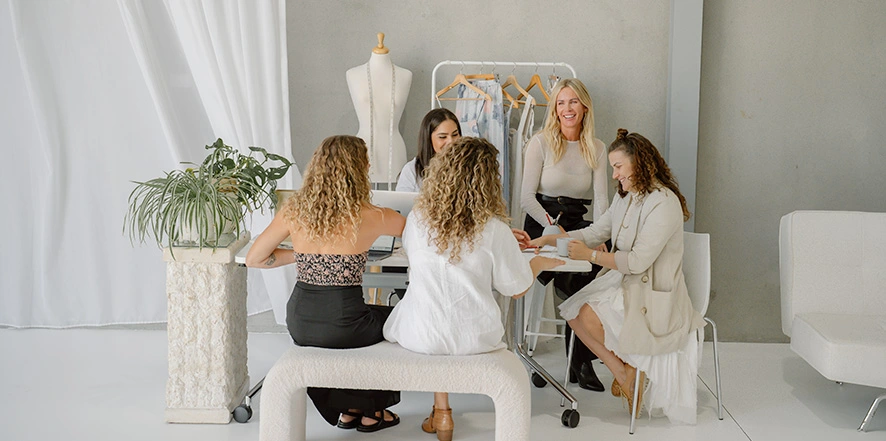
Clothing brand owner in an Appointment with senior designers to create create a new clothing line / collection with Visionise

Testimonial and customer review for Visionise Fashion Design & Manufacturing

Interested in our articles?

Subscribe to our blog

Related Posts

Subscribe to our newsletter

Your email is safe with us, we dont spam!